

When Governance Fails, Communities Pay the Price
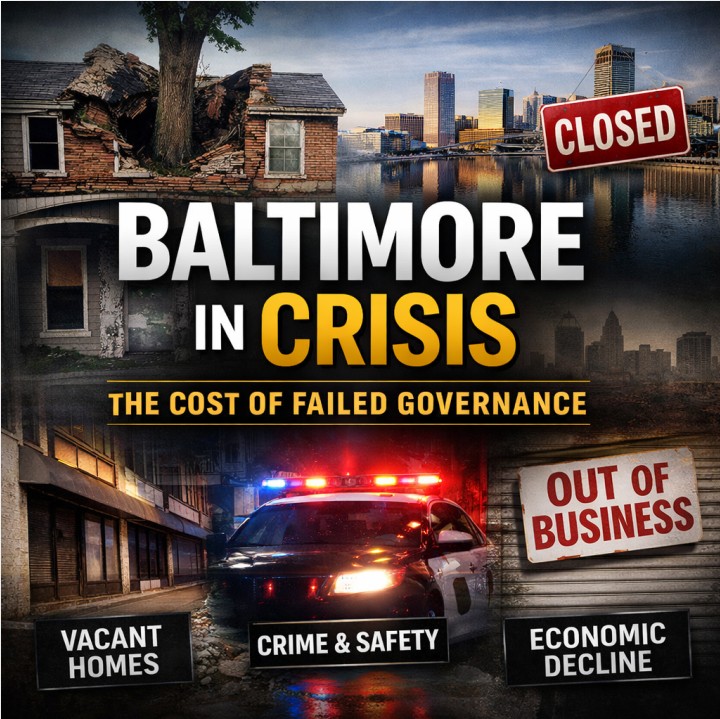
What we are witnessing in parts of Baltimore is not simply the result of time or chance. It is the result of governance. Or more precisely, the absence of good governance.
For decades, Baltimore has struggled with vacant housing, declining commercial corridors, and population loss. According to the Baltimore City Department of Housing and Community Development, the city has long dealt with tens of thousands of vacant and abandoned properties, many of which pose safety hazards and drag down surrounding neighborhoods. These are not just empty structures. They are fire risks. They are magnets for crime. They are, quite literally, places where opportunity once lived and has since disappeared.
A functioning city government should not allow a home to sit abandoned long enough for a tree to grow through it. That is not a partisan statement. That is a basic expectation of competence.
Downtown Baltimore tells a similar story. The Inner Harbor, once a national model for urban revitalization, has seen a wave of store closures and declining foot traffic in recent years. Harborplace, the crown jewel of that revitalization, has struggled to maintain tenants and relevance in a post pandemic economy. Major retailers and restaurants have shuttered. The Gallery Mall has become a shadow of its former self. These are not isolated failures. They are symptoms of a broader economic and planning breakdown.
Now, to be clear, Baltimore is not alone in facing these challenges. Cities across the country have been grappling with the aftershocks of COVID-19, shifts in retail patterns, and remote work trends. San Francisco, Chicago, and even Washington, DC have seen similar issues. But the difference lies in the depth and persistence of the problem in Baltimore.
Good governance requires acknowledging reality. It requires measuring outcomes honestly and adjusting course when policies are not working. That has not happened consistently in Baltimore.
A core principle of conservative governance is accountability. Taxpayers deserve to know that their dollars are being used effectively to maintain infrastructure, ensure public safety, and promote economic growth. When entire blocks sit abandoned, when businesses flee, and when residents choose to leave rather than invest in their communities, accountability has broken down.